
How digital tools are changing democracy
Anastasiia Romaniuk presents the first findings of her research on digital innovations in communities
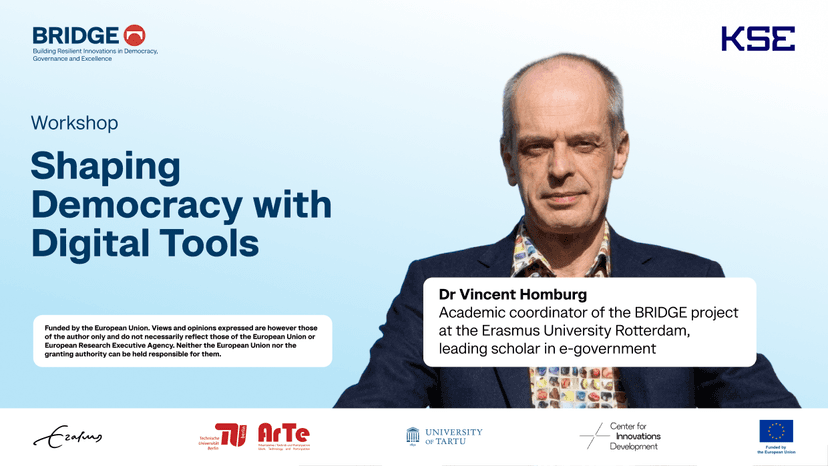
On 27 and 29 October 2026, a two-day online workshop entitled "Shaping Democracy with Digital Tools" was held for KSE University researchers as part of the BRIDGE project. The workshop marked the first stage of a training programme focused on analysing the impact of digital tools on democratic processes. It was designed and facilitated by Dr Vincent Homburg, Associate Professor of Public Administration at Erasmus University Rotterdam, a leading scholar in the field of e-government.
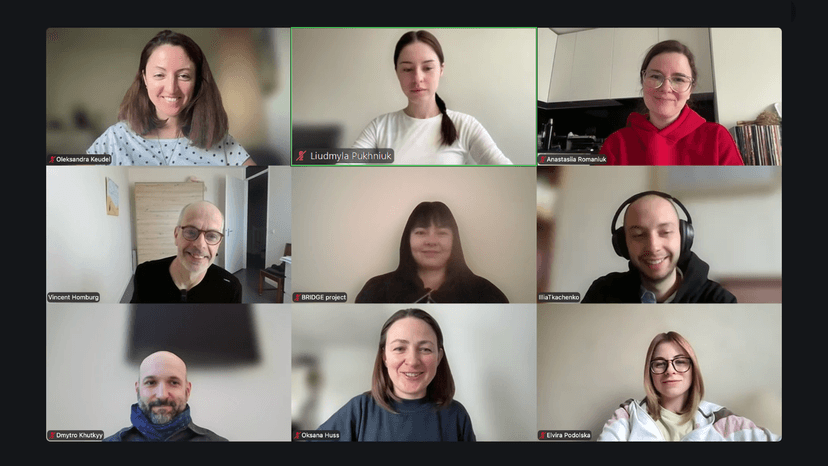
During the workshop, Anastasiia Romaniuk, a BRIDGE project researcher, presented two cases from her ongoing research to her colleagues.
She conducted interviews with local government representatives in Vinnytsia, Myrhorod, Makariv, Kamianets-Podilskyi, Slavutych and Tereshky to find out how communities use digital tools when making decisions. These include digital twins (digital models of a community's territory used for spatial planning and development), an automated energy consumption monitoring system, and even a school canteen app that provides the entire school meals system in a community with the necessary data – from parents to procurement officers.

A few observations from Anastasiia's research
- New tools in communities are mostly introduced thanks to the leadership of a few motivated employees, who rarely find broad support among their colleagues beyond a small circle of like-minded people. However, their efforts do not always translate into lasting institutional change. Horizontal links between communities are also often drivers of innovation, including informal exchanges of experience between professionals working in relevant fields and participation in professional events and conferences.
- Local self-government bodies introduce digital tools to work faster. However, these tools can sometimes have the opposite effect, increasing the need for bureaucracy in order to standardise processes. They may also cease to function as soon as funding or technical support comes to an end.
- Communities are often compelled to introduce such tools not to improve efficiency, but to overcome artificial barriers to accessing the data they need, resulting from shortcomings in the regulatory framework.
- Communities are often compelled to introduce such tools not to improve efficiency, but to overcome artificial barriers to accessing the data they need, resulting from shortcomings in the regulatory framework.
"I do not subscribe to the idea that all communities must go digital: even the most successful ones rarely have the capacity to do so. The interviews show what this requires: substantial funding, specialists who are difficult to attract to local self-government bodies due to salary constraints, overcoming colleagues' resistance and managing change, complex administration involving the risk of criminal liability, and many other challenges. That is why one of the first questions I asked my interviewees was: 'Why and how do you do this, despite all the circumstances being against you?'
Most importantly, those who want and are able to introduce digital innovations should be given the opportunity to do so in a safe, transparent and democratic way. There are already many such practices. This is why the research aims to develop a realistic and critical perspective on digital innovations in communities, highlight good practices and help scale them up, as well as reflect on the benefits and implications of the datafication of local governance in wartime," says Anastasiia Romaniuk.
Workshop participants also discussed whether the war accelerates digital change or, rather, exposes weaknesses that already existed within institutions. There is no clear answer yet. The war often has an indirect impact, even when respondents themselves do not associate changes in their work with it.
What comes next
Anastasiia will continue her fieldwork, but will now focus not on communities as a whole, but on specific cases of digital solutions used by communities.
The research findings will provide the basis for an academic article and a teaching case for use at universities. Dr Vincent Homburg has agreed to lead the development of both outputs. Two colleagues who took part in the programme will be invited to a research visit in Rotterdam, which will include an in-person workshop to prepare both outputs for publication.
We would like to thank Vincent Homburg for his mentorship, expert insights and support in developing the team's research! Once Anastasiia completes her research, we will be sure to share its findings.