
Social resilience: Lessons from Ukraine on the Ukraine Podcast UTUC
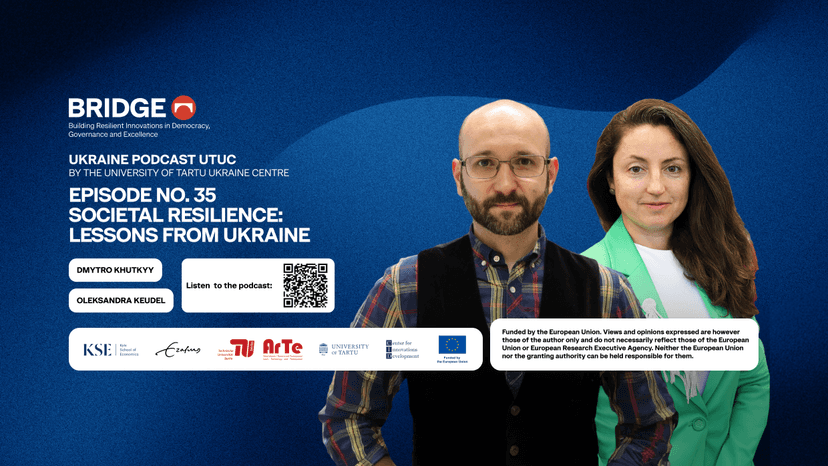
A new episode of Ukraine Podcast UTUC featuring Dmytro Khutkyy and Oleksandra Keudel
“Resilience emerges when, under the pressure of war, economic disruption, or other shocks, a system changes its forms, tools, and rules without losing its core”.
In the latest episode of Ukraine Podcast UTUC, Dmytro Khutkyy, Head of the University of Tartu Ukraine Centre and co-investigator in the BRIDGE project, and Oleksandra Keudel, Associate Professor at the Kyiv School of Economics and co-investigator in the BRIDGE project, move beyond “resilience” as a buzzword to explore how it functions in practice in Ukraine.
The researchers compare two approaches to studying resilience, examining what each reveals — and what it may obscure. The first views resilience as a response to a single, defining shock, such as Russia’s full-scale invasion of Ukraine. The second understands resilience as a system’s capacity to withstand a cascade of successive war-induced crises: the displacement of millions of people, the destruction of critical infrastructure, and sustained institutional strain.
During the conversation, Oleksandra and Dmytro discuss which indicators best capture resilience in real life. They note that conventional research often overlooks critically important dynamics — such as how people self-organise into informal networks and how civic cohesion actually works. In this respect, Ukraine already offers experience that can serve as a valuable lesson for other countries affected by conflict.
The discussion also touches on democratic resilience, specifically how people continue to contribute to decision-making during challenging times while upholding democratic values. Oleksandra shared her experience of a Citizens’ Assembly in the city of Zhytomyr in autumn 2025 as part of the BRIDGE project. In her view, this case demonstrated that dialogue remains effective even under the most challenging conditions. Thanks to random selection, people who had never before influenced city life took part in discussions on transport infrastructure and sustainable mobility. When residents with diverse perspectives begin to truly listen to one another, their trust to each other and a sense of belonging to the community grow. The ability of people to discuss complex and contentious topics is an important element of resilience that affects cohesion.