
Policy Labs: how collaborative solutions transform community development
The BRIDGE project team is learning from the Netherlands’ experience in establishing Policy Labs in cooperation with researchers from Erasmus University.
Complex challenges such as environmental crises or urban planning do not always have simple solutions. Traditional approaches, where laws and regulations are designed behind closed doors, often fail to take into account the real-life experiences of people on the ground. This is why Policy Labs are increasingly emerging in different countries — spaces for testing ideas in practice, where public officials, researchers, and residents jointly examine concrete solutions before they become official policies or legislation.
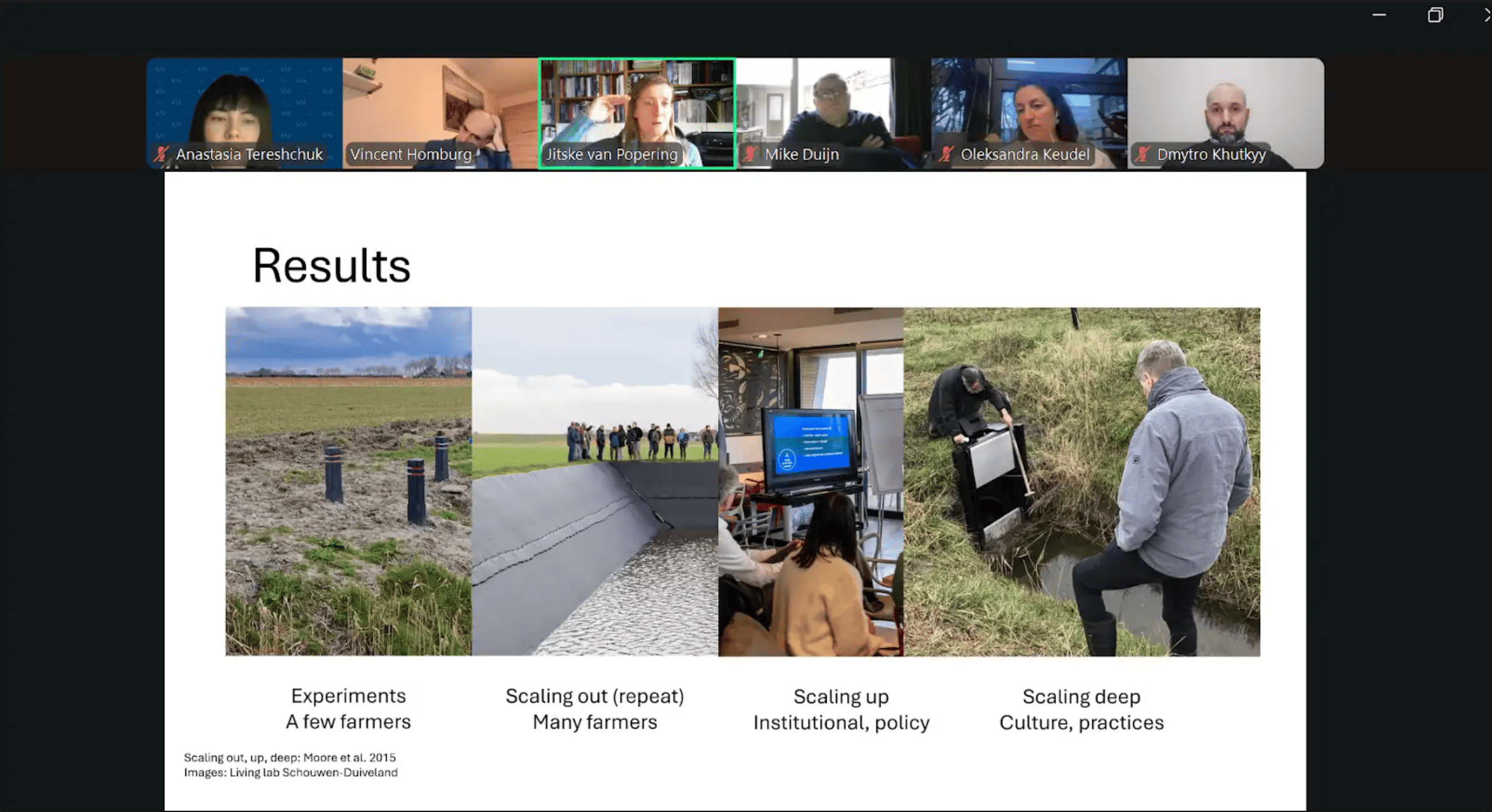
This very approach was the focus of a recent online meeting between the BRIDGE team and researchers from Erasmus University Rotterdam. During the meeting, Dutch experience was shared by Mike Duijn and Jitske van Popering — senior researchers and heads of the Hoovermer and Hooverloo units at Erasmus University Rotterdam. The discussion was moderated by Professor Vincent Homburg, a representative of the university.
The researchers presented two practical case studies:
- Water resource management. Over the course of five years in rural areas of the Netherlands, farmers and researchers worked together to identify ways to use water more sustainably. The solutions developed during this period will now form the basis for new national standards and institutional changes.
- Land subsidence in Rotterdam. This is a technically complex issue that affects the condition of residential buildings in the city. Through a Policy Lab, architects and urban planners developed scenarios to address the problem. The experts proposed several solutions: renovating existing buildings or completely redeveloping neighborhoods to incorporate water collection systems and thus protect building foundations.
Both cases once again confirmed the idea that even well-coordinated collaboration among professionals will not deliver the desired results without the involvement of the people directly affected by these decisions.
Why is this relevant for Ukraine?
Reforms work when people understand them and feel involved in the process of change. Policy Labs make it possible to move beyond formal meetings and bring to one table those who make laws, those with professional expertise, and those whose lives will be shaped by these laws. In the context of war and future recovery, it is crucial not to replicate outdated approaches, but to develop new solutions based on trust between citizens and public authorities.
The knowledge gained during the meeting will become an important part of preparations for the next stage of the project. In 2026, the BRIDGE team plans to hold a Deliberative Democracy Workshop that will bring together key representatives of civil society and government. This workshop will serve as a practical platform for developing inclusive and effective participation tools grounded in deliberative principles, helping to foster a culture of shared decision-making in Ukraine.
The practical implementation of these insights lies ahead, and we will be sure to share the results of this work on BRIDGE’s social media channels. Follow our updates so you don’t miss a thing!