
Oleksandra Keudel at the International Observatory on Participatory Democracy in Kraków
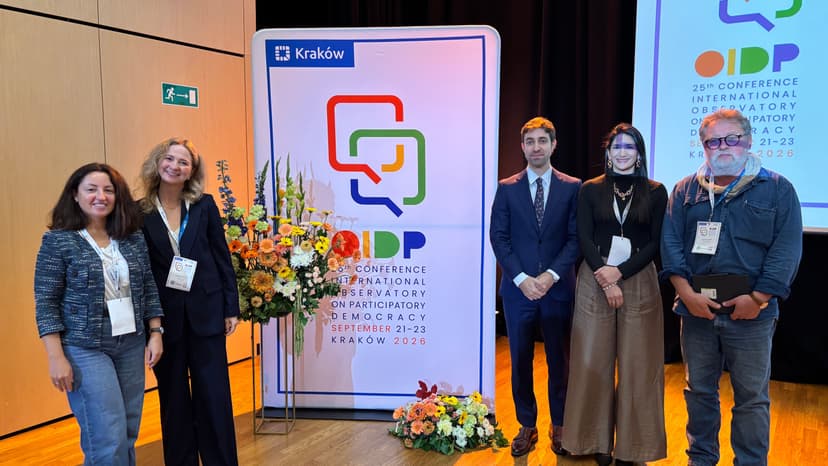
Oleksandra Keudel, Principal Investigator of the BRIDGE project at KSE, spoke at the opening of the 25th International Observatory on Participatory Democracy (OIDP) International Conference, held on 21–22 September in Kraków.
Around 200 participants from Europe, Africa, and Asia gathered for the conference. Some of them work in contexts where even saying the word "democracy" is not easy. The discussion therefore brought together perspectives from people living and working in very different political and regional realities.
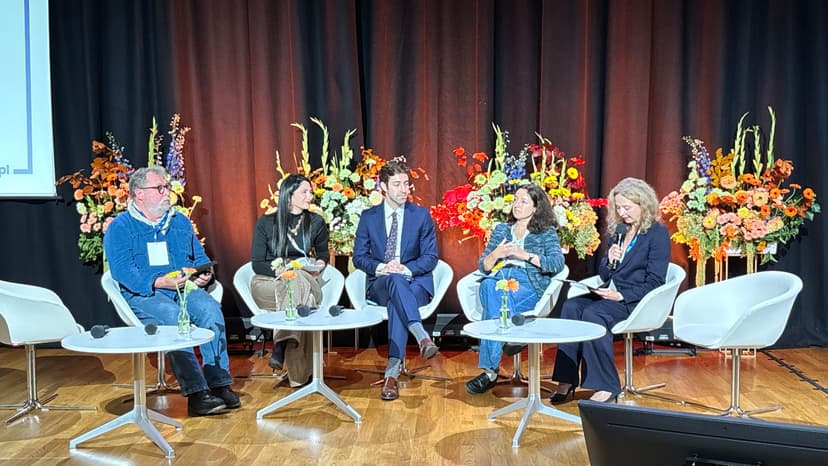
Oleksandra joined a panel discussion on the challenges facing democracy and approaches to strengthening democratic resilience, alongside Diana Dajer (OIDP), Miquel Vidal Bover (OECD), and Jakób Wygnański (Stocznia Foundation). The discussion was moderated by Paulina Pospieszna from Adam Mickiewicz University, a member of the BRIDGE advisory board.
Some key takeaways from the discussion:
Democratic resilience cannot be assessed solely through economic indicators or individual well-being.
"In Western Europe, democracy has become too closely associated with citizens' well-being. When living standards decline, people lose trust in democracy. The OECD data shared by Miquel Vidal Bover show that a sharp decline in living standards is the main reason for people's disillusionment with democracy. But democracy is not about individual well-being – some autocracies are better at providing that. It is about the right to be human and the rule of law, which protects people from the arbitrary exercise of power by the state or other individuals," Oleksandra said.
It is important to return to the essence of democracy. Human rights, individual freedoms, and the rule of law are the foundations of democracy, not secondary features of a political system. Democratic institutions must protect people from the arbitrary exercise of power.
The experience of Ukrainian regions and communities that have experienced or are currently experiencing russian occupation shows what happens when authoritarian forces prevail: the mass graves in Izium; occupied Oleshky in the Kherson region, where people are suffering from food shortages, while russia neither allows them to evacuate nor provides assistance to those who remain – mostly older people and people with disabilities.
"Democratic states fall shortest precisely at the international level. Unfortunately, economic interests have overshadowed strategic considerations. As a result, economic cooperation with russia, the main threat in our region, continued to deepen while it interfered in Moldova's affairs, terrorised Ichkeria, invaded Georgia and committed war crimes in Syria, until it was slowed down by the Armed Forces of Ukraine. Even now, many companies have not left russia, and business ties remain in place. This is partly due to interdependencies which, I fully understand, are not easy to break after decades of investment," Oleksandra added.
We would like to thank OIDP The International Observatory on Participatory Democracy, UCLG Committee on Social Inclusion, Participatory Democracy and Human Rights, and Paulina Pospieszna for the invitation!