
Zhytomyr’s citizens’ assembly at Europe’s largest Ukraine-focused event — Cafe Kyiv
The BRIDGE team and the Zhytomyr city council, together with REDEMOS, presented the experience of the citizens’ assembly in Zhytomyr at Cafe Kyiv
.png&w=828&q=75)
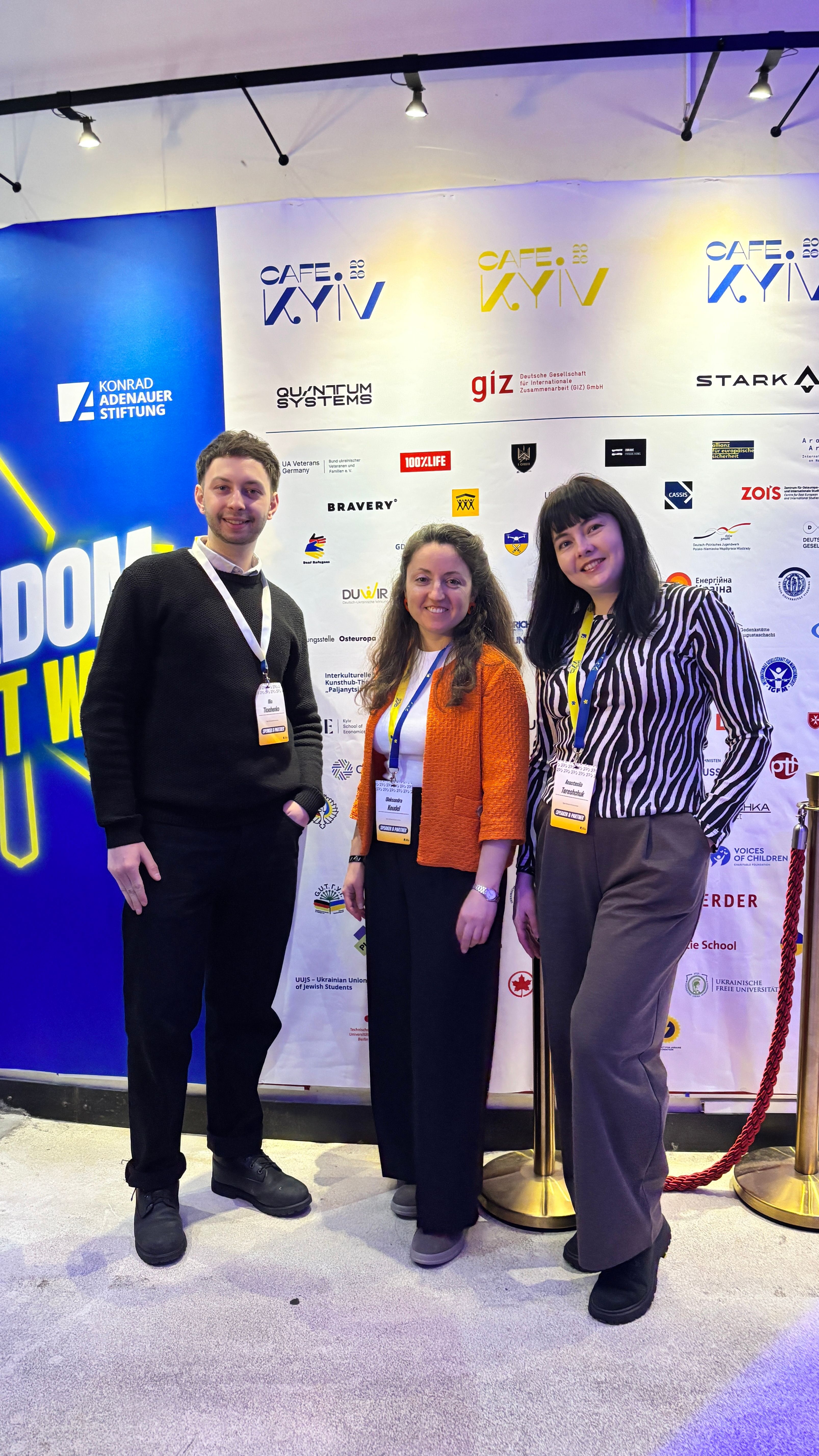
On 23 February, on the eve of the fourth anniversary of the full-scale Russian invasion, the fourth Cafe Kyiv took place in Berlin. Organised by the Konrad-Adenauer-Stiftung, it is one of the largest European events dedicated to Ukraine. Each year, the event brings together representatives of civil society, researchers, entrepreneurs, politicians, diplomats, and European institutions, including the European Commission and the European Parliament.
The discussion “Reconfiguring Democracy through Deliberation: Lessons from the Citizens’ Assembly on Sustainable Urban Mobility in Zhytomyr” featured Dr. Oleksandra Keudel (Director of the Center for Democratic Resilience at the Kyiv School of Economics and lead principal investigator of the BRIDGE project), Dr. Kerstin Lücker (Head of the Technology and Participation Unit at Technische Universität Berlin), Oleksandr Cherniakhovych (Adviser to the Head of Zhytomyr City and Chair of the Committee on Deputies’ Activities, Procedures, and Compliance with Legislation of the Zhytomyr City Council), and Dr. Maryna Rabinovych (Assistant Professor at KSE and lead of KSE’s contribution to the Horizon Europe REDEMOS project). The panel was moderated by Illia Tkachenko, citizens’ assembly coordinator at the Center for Democratic Resilience at KSE, specialising in participatory urban development.
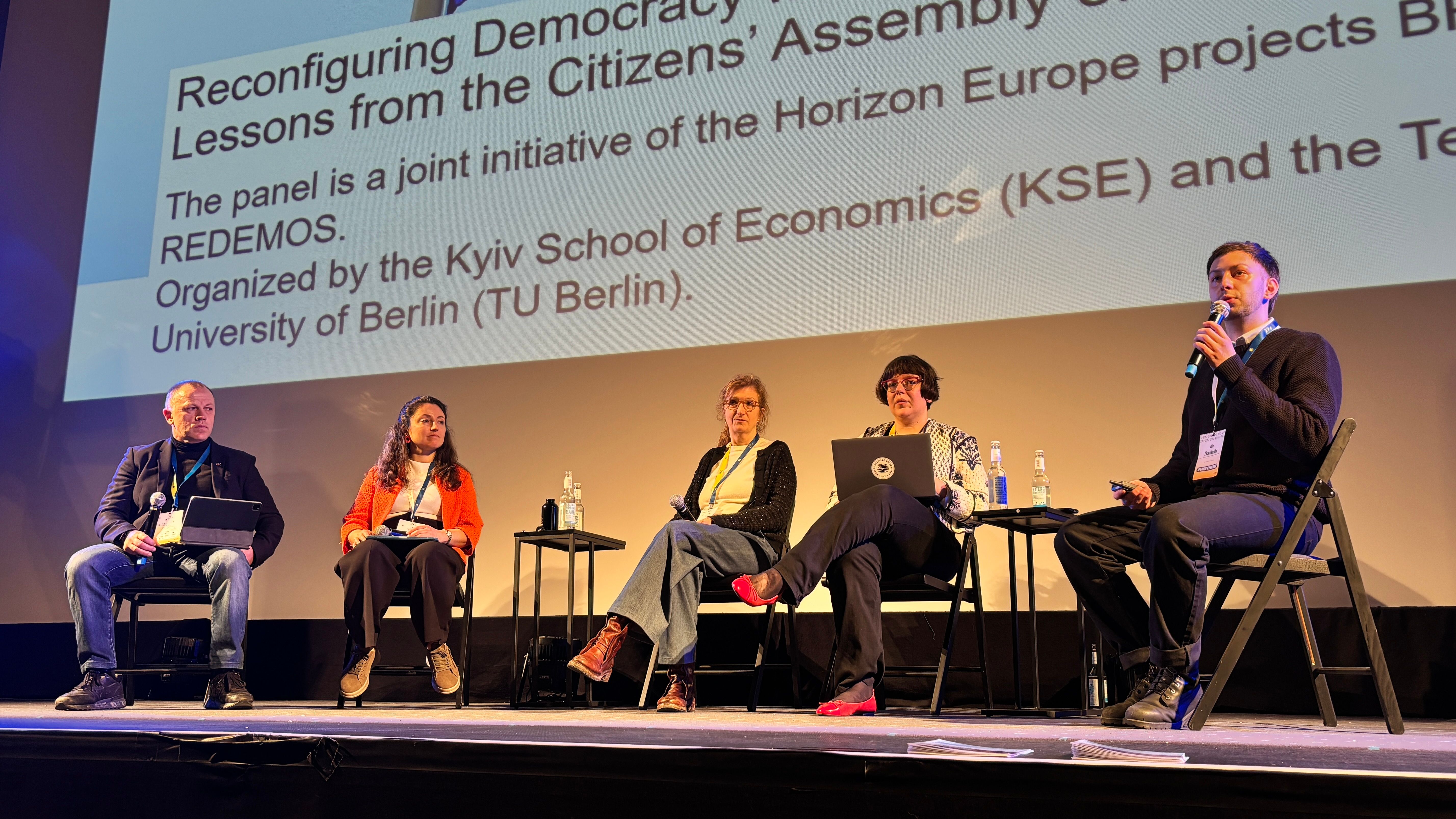
The discussion focused on the experience of organising the citizens’ assembly in Zhytomyr during the full-scale war. The speakers presented the results and the architecture of the process, including how the team first established a stakeholder forum and an advisory committee to accompany the assembly and build trust in the process. In parallel, they conducted a broad media campaign — explaining how participants were selected, how the agenda was shaped, and how recommendations were adopted. These elements — procedural transparency and continuous communication — are often underestimated or insufficiently systematised in European practice.
For the European Union, this is not an abstract issue. In many EU countries, trust in public authorities is declining, and doubts are emerging about the added value of deliberative tools. The Ukrainian experience demonstrates that transparency and clear rules determine whether citizens’ assemblies are perceived as a formal procedure or as a recognised mechanism of public influence.
Even during the war, the local authorities and citizens of Zhytomyr invested time and resources in meaningful participation to develop shared solutions. For many Europeans, democracy is taken for granted. In Ukraine, it is not a given, but something that must be sustained and defended. This is precisely why this experience matters for the EU: it restores the sense that democracy is a process that requires continuous support and renewal.
The discussion also addressed the next step for Ukraine — institutionalisation. After several pilots with citizens’ assemblies, the key challenge is to integrate them into established decision-making processes. How to do this in a way that reflects the Ukrainian context remains a task for co-creation with all relevant stakeholders.
Today, Ukraine is not only receiving support but also shaping practices that may be valuable for other countries. Citizens’ assemblies in Ukrainian cities demonstrate how democracy can be renewed systematically rather than declaratively — and how this can be done at a time when it would be easiest to put participation on hold.