
Fourth meeting of the Deliberative Democracy Lab
Digital Deliberation
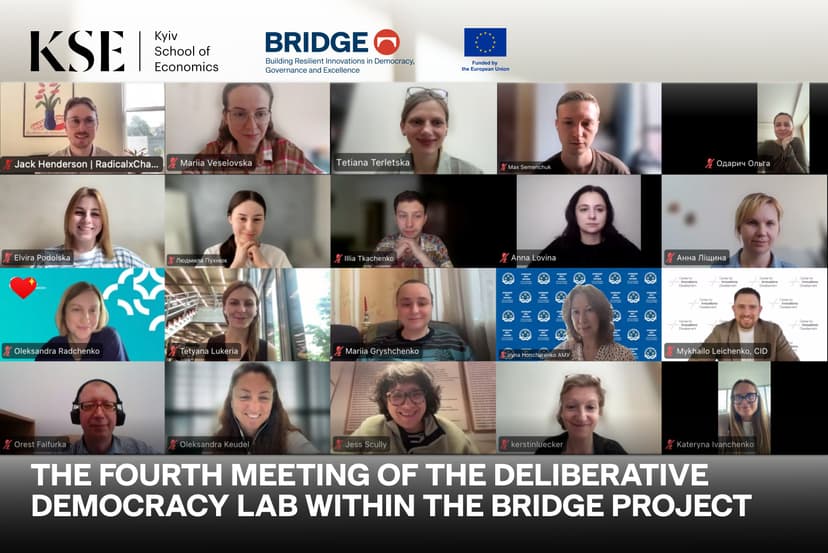
On 16–17 June 2026, the fourth online session of the Deliberative Democracy Lab took place within the BRIDGE project. This time, participants focused on digital deliberation.
It was important for us to reflect on how deliberation can be brought into the digital sphere while preserving its core nature: a collective search for agreement, in which people exchange arguments and weigh different perspectives in an environment free from undue influence. Digital platforms can make discussions involving large numbers of people from different locations more accessible and less costly than in-person participation. The challenge, however, is how to ensure meaningful consideration of problems and solutions rather than simply expressing opinions, and how to reach agreement rather than merely deciding by majority vote.
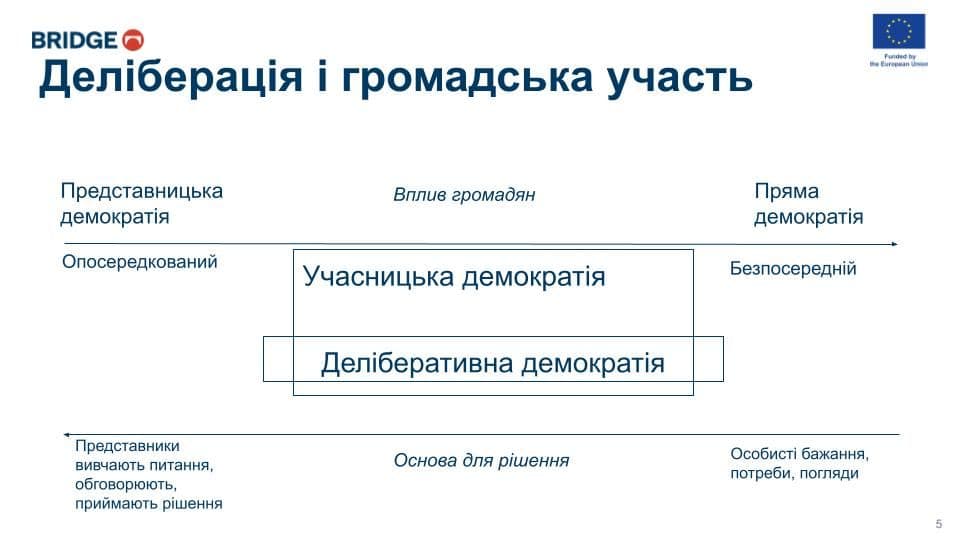
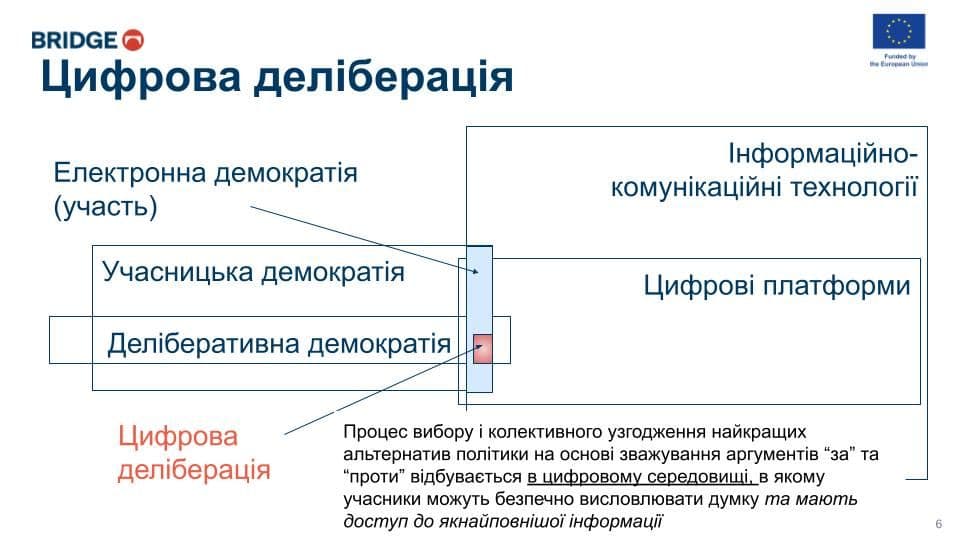
These objectives were outlined during the opening session by Oleksandra Keudel, BRIDGE Scientific Director, and Kerstin Lücker, Head of Technology and Participation at the Technical University of Berlin. The programme then provided an overview of Ukrainian and international priorities and practices in digital deliberation.
Kateryna Podust, Head of the Expert Group for the Implementation of E-Governance at the Directorate for E-Governance and Public Services of the Ministry of Digital Transformation of Ukraine, spoke about Ukraine’s priorities in digital democracy. She highlighted that the Ministry is preparing an update to the Diia ecosystem that will simplify the provision of feedback from local authorities to citizens. The new solutions are not intended to replace the platforms already used by local self-government bodies, but rather to provide an option for those that do not yet have their own platforms.
Maksym Semenchuk, Adviser to the Ministry of Digital Transformation of Ukraine, presented the Ukrainian Civic Tech Lab initiative. The initiative seeks to build a community of practitioners with a particular focus on the local level, recognising that embedding digital democratic practices in society encourages their adoption by public authorities as well.
International experience was presented by Jess Scully, Executive Director of RadicalxChange, together with her colleague Jack Henderson. They demonstrated that the value of digital deliberation goes far beyond scale or lower participation costs and proposed five principles for effective digital deliberation:
- seeking unexpected areas of agreement among people with different experiences and perspectives
- making participation quick, fair and engaging
- developing civic skills and community capacity through the practice of "Broad Listening"
- supporting local expertise within communities and civic groups
- adapting the mechanisms of state and municipal institutions to enable meaningful participation in political decision-making.
RadicalxChange Foundation is an international community of programmers, researchers, artists, activists and entrepreneurs working to renew democratic and economic institutions, develop the internet as a public good, promote open access to algorithms and create solutions that strengthen citizens’ influence over the future.
Estelle Ciesla, Research Consultant at Stanford University's Deliberative Democracy Lab, introduced participants to deliberative polling and the online platform developed by Stanford University, which enables thousands of people to engage in deliberative discussions. This approach has already been used in more than 50 countries, from the United States to China. In Mongolia, constitutional amendments cannot be adopted without such a deliberative poll.
Oleksandra Radchenko, Public Participation Expert, EGAP Programme, East Europe Foundation, presented the Unified Local E-Democracy Platform (E-dem), which enables residents to participate in decision-making processes. As a step towards digital deliberation, the platform includes the "Document Discussions" module, allowing users to discuss sections of draft regulatory acts prepared by local self-government bodies, express approval or disapproval, and leave comments.
Mykhailo Leichenko, Director of IT and Analytics at the Center for Innovation Development (CID), shared initial experiences of digital deliberation using Polis as part of the development of municipal investment projects. He also presented a CID study that analysed 53 international e-democracy tools and concluded that digital participation should be viewed as an integral component of democratic institutions. Only then can it realise its full potential and make efforts to implement it worthwhile.
We would like to thank Illia Tkachenko, Research Coordinator at the BRIDGE project and at the Centre for Democratic Resilience at KSE, and Tetiana Terletska, Chief Operating Officer of the NGO "Community Development and Cooperation Centre" and Advisor to the Deliberative Democracy Lab of the BRIDGE project, for coordinating the Lab. We are also grateful to all speakers for sharing their experience and practical tools, and to all participants for their interest and engagement in this shared endeavour!
The Deliberative Democracy Lab is a platform for exchanging ideas and experiences with the aim to identify effective adaptations of international deliberative practices to the Ukrainian context. The Lab’s ultimate goal is to develop recommendations for the effective integration of deliberative democracy into Ukraine’s public participation system.